[Case 01]
Manager - From internal tool to self-serve SaaS
SaaS · KYC/KYB
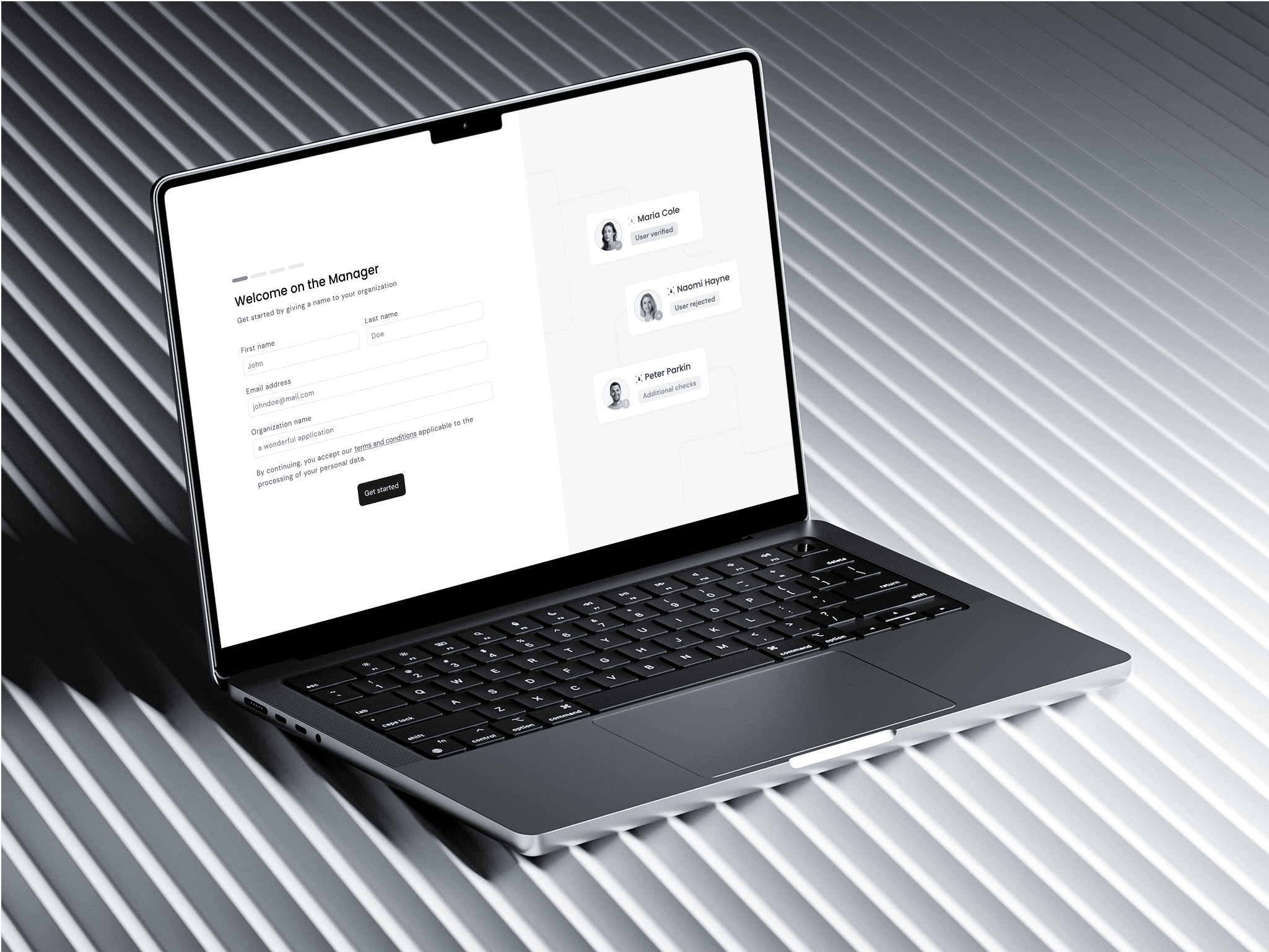
From sign-up to live KYC flow in under 30 minutes turning a service into a product
[Project Overview]
Manager was Synaps' internal tool our team configured client verification flows from briefs and calls. As clients scaled, the model broke: response times stretched, clients waited. We decided to ship Manager as a user-facing SaaS so clients could own their flows. This case study focuses on the onboarding path: from sign-up to first published KYC flow without contacting our team.
[Problem Statement]
Every client flow change went through Synaps. A dedicated team translated calls and forms into Manager configurations. The model didn't scale and it created a bottleneck precisely when growth required speed. Compliance officers the people who knew what they needed had no way to act on it. Manager needed to become something they could open and use on their own.
[Industry]
SaaS · KYC/KYB
[My Role]
Product Designer
[Platforms]
Desktop
[Timeline]
2024 · 6-month sprint
[How we found it]
Compliance officers, devs, and PMs
Three roles, one onboarding observed across 15+ client calls
"Clients knew their flows better than we did, they just couldn't act on that knowledge. The new Manager had to speak their language, not ours."
Shadowed 15+ client calls
1:1 interviews with prototypes
Competitive benchmark
Confirmed personas
[The deeper problem]
Manager existed before our design system stack debt and dated patterns.
Every change funneled through us, creating a bottleneck as clients scaled.
Compliance officers the real experts couldn't touch the system that ran their flows.
[Constraints]
6-month deadline, with high-volume clients onboarding mid-project.
New tech stack imposed, design system adoption, functional parity required.
Poor mobile optimization that slows her down.
[Process]
Map the onboarding mental model
Four anchors: Sign-up, Organization setup, First application, Team invite.
Sequence validated through 15+ interviews and BizDev shadowing.
Compliance officers as primary persona, devs and PMs as secondary.
Pre-pave the path with templates
Three KYC templates: Basic, +AML, Advanced (KYC+AML+PoA).
Empty flow kept as fourth option full custom for non-standard cases.
Cuts time-to-first-flow without locking power users out of full control.
Visual builder, not configuration form
Cards on a canvas, connected by lines direct manipulation.
Each step adds, removes, or reorders without leaving the flow view.
Borrowed the mental model from workflow editors like n8n and Zapier.
Dashboard structured around three commitments
Create flow → Integrate → Publish. Each step is a visible commitment.
Sequential gating: locked steps unlock only when prerequisites are met.
Users always know what to do next, and what success looks like.
[Outcome]
Drop in support tickets after launch. Clients started owning their flows.
Client projects onboarded through the new Manager and published in production.
No bugs surfaced on flows published live. The builder enforced valid configurations by design.
[Key Learnings]
Self-serve is about pre-paving paths
Templates removed friction for the standard cases; full custom stayed available for the rest. Neither alone would have worked.
Visual builders beat configuration forms
Flow logic is spatial in users' heads cards on a canvas reflect that. A form would have hidden the structure behind fields.
Roles should have been more granular
If I did it again, I'd separate flow creators from session reviewers from risk controllers. Each persona deserves its own surface.